
The recent civic unrest in Iran has been enveloped in a media fog and has polarised binary narratives, making an objective analysis difficult. Yet, given Iran’s geopolitical importance and economic potential, such a granular exercise is required, particularly as it lies in India’s extended proximity.
The genesis of the ongoing crisis lies in the increasingly dire eco-political conditions. It began on December 28, 2025, when a group of Tehran merchants (“Bazaari”) staged a shutdown to protest the frequent devaluation of the market value of the rial, the national currency. While the rial’s official exchange rate to a dollar was 42,000, the market rate was nearly 35 times lower at 1.45 million, having fallen 20,000 times since the Islamic Revolution in 1979. Its 45% decline in 2025 made importing essential commodities such as rice, sugar and edible oil and selling them in the rial at officially controlled prices, unprofitable.
Solimo 2000/1000 Watts Room Heater
Adjustable thermostat • ISI certified • Ideal for small to medium rooms
📦 Featured Product Recommendation
Below is a top-recommended product you can buy on Amazon — support us by using the link below (we earn a commission at no extra cost to you).
🔗 Buy on Amazon* Shop with confidence — Amazon Affiliate Link

RR Signature WARMAXX Room Heater
Dual heating mode • Overheat protection • 5-level safety • 2 year warranty
View on AmazonBorosil 2000W Novus Electric Fan Heater
Made in India • Variable temperature • Horizontal & vertical placement
See Details on AmazonSubsequently, other disaffected sections of the population, such as unemployed youth and low-paid employees, also joined the stir, making it a country-wide anti-government movement. Arson, vandalism and anti-establishment violence were reported. On January 13, authorities disclosed that over 2,000 people had died during the unrest, blaming the casualties on unnamed “terrorists”.
Crises and the official playbook
Since the founding of the Islamic Republic in 1979, the authorities have perfected a four-stage playbook for dealing with recurring mass civic unrest, as seen in the election fraud in 2009, petrol price hike in 2019 and Hijab protests in 2022 — none of which succeeded. In the first phase, stern police action is taken to contain the law-and-order problem. If the agitation persists, a “good-cop, bad-cop’ routine is played: while some high officials warn of enemy conspiracies, others exude sympathy for the “legitimate grievances”, offering talks and concessions. Social media is locked down. The third stage involves weeks of attrition, seeding confusion, splitting the organisers and holding pro-government rallies. These three stages normally succeed in tapering off the protests. Thereafter, the leading protesters are rounded up and sentenced exemplarily with long prison terms or even execution. During all this time, the western media plays the role of an agent provocateur to the hilt.
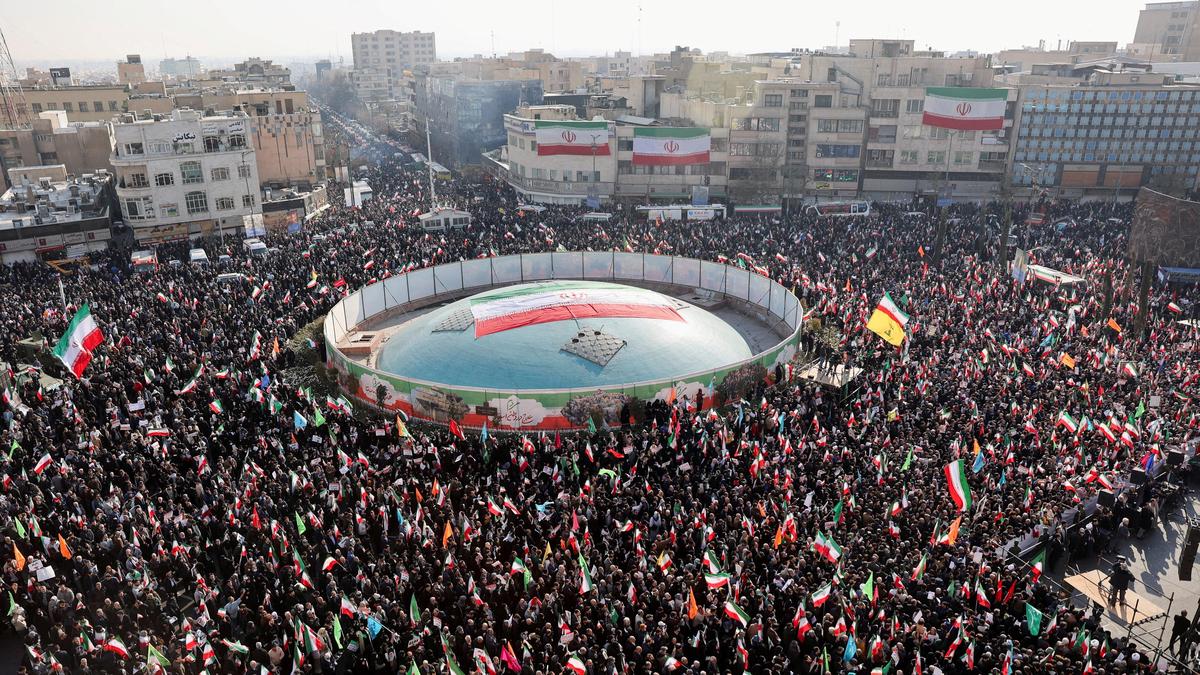
The current melodrama now seems to be entering the third phase. Over the next four months, a token 10 million rials ($7), as a monthly handout, will be directly transferred to all citizens to mitigate inflation. The funerals of the security personnel killed and pro-establishment rallies were accompanied by a denunciation of foreign attempts to hijack the agitation.
The Pasdaran (Islamic Revolutionary Guards Corps or IRGC) and the army have stayed loyal, condemning the agitation as a continuation of the 12-day Israel-United States war of June 2025 against Iran. The oil industry, the mainstay of the national economy, has stayed unaffected, and the governing elite has also not splintered. Moreover, no alternative leadership has emerged among the protesters.
The dynamics in Iran, foreign threats
Although the establishment seems to have managed to overcome the protest, the outbreak has exposed new systemic vulnerabilities. First, the Bazaari strike against the clergy-led regime was unprecedented. In Iran’s modern history, the Bazaaris have been an influential bellwether lobby, at times forcing Iranian rulers to retract. Their withdrawal of support doomed the Shah in 1979. Their informal symbiosis with the clergy initially permitted profiteering from unfettered imports at a preferred exchange rate and selling domestically at market rates.
However, during the past two decades, this bromance has cooled. The economic conditions worsened mainly due to the U.S.’s “maximum pressure” sanctions. Further, they were also squeezed by the IRGC and the Bonyads (various ostensibly charitable foundations for war veterans, widows and orphans), muscling into lucrative sectors of trading, manufacturing and contracting. While Iran’s President, Masoud Pezeshkian, recently claimed resolution of the merchants’ grievances, the details have not been made public. It remains to be seen if the omnipotent IRGC, currently crucial to government survival, would agree to roll back their businesses.
Second, while Tehran may have tactics to curb protests, the ruling elite lacks eco-political levers to fix the root causes of the recurring social convulsions. The Iranian leadership’s steadfast pursuit of a nuclear and missile programme and support to regional proxies diverts scarce economic resources and triggers western economic sanctions, causing social angst.
Over two-thirds of Iranians were born after the Revolution and have different aspirations than their gerontocratic politico-theocratic leadership. They see the affluence of their Gulf Arab neighbours and hold the leadership responsible for their abject penury. They also notice the kleptocracy and corruption in the top echelons of power. Moreover, with radicals in control of the clergy, parliament and judiciary, and a relatively powerless executive, significant social groups, such as women and non-Shia minorities feel alienated. While the managed election of a moderate President in 2024 raised hopes, these have been belied due to regional turmoil.
Third, the foreign abatement of the agitators has become mainstream, with U.S. President Donald Trump and Israeli Prime Minister Benjamin Netanyahu openly encouraging them with military threats to punish the Iranian regime and possibly replace it. However, they lack any smart and easy options, and the outcome of any precipitous foreign action cannot be guaranteed. In 1980, Iraqi President Saddam Hussein attacked Iran to exploit the post-Islamic revolutionary chaos, only to see all Iranians unite against foreign aggression. Moreover, Iran’s Shia majority has a long tradition of glorifying martyrdom and sacrifice, making them more inured to foreign military threats.
Despite its losses during the June 2025 military bout with Israel and the U.S., Iran retains sufficient retaliatory capability to thwart a repetition. Tehran’s options include targeting U.S. interests in the geoeconomically sensitive and febrile region, making the Gulf Arab states wary about paying for a U.S. military misadventure.
Moreover, when driven to a corner, Iran could close the Strait of Hormuz, raising global oil prices. Mr. Trump has often criticised his predecessors for dragging the U.S. into “endless wars” and has so far avoided having “boots on the ground”, preferring surgical airborne strikes and smart economic coercion. Although he has been emboldened by his tactical success against President Nicolás Maduro Moros of Venezuela, there is a clear realisation that the multiplicity of power centres in Iran makes military decapitation a risky and even counter-productive endeavour.
Instead, Mr. Trump is veering toward non-kinetic measures such as cyberattacks and the imposition of secondary punitive tariffs on the countries trading with Iran, encouraged by the outcome of a similar exercise in curbing Indian imports of Russian crude. Their efficacy remains uncertain as Iran has long been subject to Israeli cyberattacks and has a well-oiled sanctions-busting machinery in place, from marshalling cryptocurrencies to dark oil-tankers smuggling crude to China and dhows to Dubai (the world’s largest trans-shipment port just 150 kilometres across the Persian Gulf).
Despite U.S. pressure, China and the United Arab Emirates are Iran’s top two trading partners, with respective bilateral commerce estimated at $40 billion and $30 billion last year, totalling over half of the entire Iranian foreign trade. The proposed secondary sanctions by the U.S. may not curb such trade but only obfuscate it. Still, as a diversionary tactic, Tehran has offered to reopen talks with Washington.
Impact on India
The notion that turmoil in Tehran is inconsequential for India is misplaced. First, any conflagration in Iran would affect the security and stability in the Gulf, where India has substantive stakes in terms of diaspora, oil supplies, remittances and trade and investments.
Second, it would allow Pakistan to project itself as a dubious security arbiter to both Iran and the Gulf Arabs and earn brownie points with the White House. India also needs Iran to access Afghanistan and Central Asia. Third, after Iran, South Asia has the largest number of Shias, with their number in India estimated at around 25 million. They are natural stakeholders in what happens to their Iranian co-confessionals. Lastly, once four decades of western sanctions are lifted, the resuscitation of the Iranian economy would provide lucrative opportunities for India, particularly as Tehran has long pursued its version of Atmanirbharta.
Mahesh Sachdev is a retired Indian Ambassador specialising in West Asia and oil affairs